

Mifflin-St Jeor Formula · Free · No sign-up

Calorie deficit calculator

Obtenez en quelques secondes votre basal metabolic rate (BMR), votre total daily energy expenditure (TDEE) et votre daily calorie goal pour perdre du poids efficacement.

Your information

Sex
yrs
cm
kg
kg

Used to estimate when you'll reach your goal.

Activity level
Weight loss pace
per week0,45 kg−500 kcal / day
MildAggressive

A deficit of 300–500 kcal/day is recommended for sustainable loss while preserving muscle mass.

Enter your age, height and weight

to get your personalized calorie goal

How does the calculation work?

Step 01

Basal Metabolic Rate (BMR)

We calculate your minimum calorie needs at rest using the Mifflin-St Jeor formula — the most accurate, based on your sex, age, height and weight.

Step 02

Total Daily Energy Expenditure (TDEE)

We multiply your BMR by a physical activity coefficient to get your actual daily calorie expenditure: this is your maintenance threshold.

Step 03

Calorie goal & macros

We subtract your chosen deficit from the TDEE to get your calorie target, then calculate the optimal breakdown of protein, carbs and fat.

What is a calorie deficit?

A calorie deficit is the fundamental principle of any weight loss. It occurs when your daily calorie intake is lower than your total daily energy expenditure (TDEE). To create this deficit, you can reduce your food intake, increase your physical activity, or combine both approaches — the combination being generally the most effective and sustainable.

For example, if your TDEE is 2,200 kcal/day and you consume 1,700 kcal, you are in a 500 kcal deficit. Over a week, that represents 3,500 kcal — approximately 0.5 kg of fat lost, since 1 kg of fat ≈ 7,700 kcal.

The Mifflin-St Jeor formula: why is it the most accurate?

Several formulas exist to estimate basal metabolic rate: Harris-Benedict (1919), Katch-McArdle, and Mifflin-St Jeor (1990). The latter is recognized as the most accurate for the general population by numerous meta-analyses, notably because it was developed and validated on a modern sedentary population, more representative of current reality.

Mifflin-St Jeor formula:

Male: BMR = (10 × weight) + (6.25 × height) − (5 × age) + 5

Female: BMR = (10 × weight) + (6.25 × height) − (5 × age) − 161

weight in kg · height in cm · age in years

Physical activity coefficients (PAL)

The TDEE is obtained by multiplying the BMR by an activity factor (PAL — Physical Activity Level) that reflects your daily physical expenditure. This coefficient is the main source of inaccuracy in calculators: be honest in your assessment for a reliable result.

LevelDescriptionMultiplier
🪑 SedentaryOffice work, little or no exercise×1.2
🚶 Lightly activeLight exercise 1–3 days/week×1.375
🏃 Moderately activeRegular exercise 3–5 days/week×1.55
🏋️ Very activeIntense exercise 6–7 days/week×1.725
Extremely activeElite athlete or physical job×1.9

Which calorie deficit should you choose?

There is no universal answer — it all depends on your starting point, your tolerance to restriction and your goals. Here is a comparison of the main approaches:

Gentle loss−250 kcal/jour

✓ Pros

  • Very sustainable long-term
  • Minimal risk of muscle loss
  • Easy to maintain without frustration

✗ Cons

  • Slow progress (~0.25 kg/wk)
  • Results barely visible short-term
Moderate loss−500 kcal/jour
⭐ Ideal

✓ Pros

  • Optimal effectiveness/sustainability balance
  • Standard recommended by nutritionists
  • ~0.5 kg loss per week

✗ Cons

  • May require an adaptation period
Fast loss−750 kcal/jour

✓ Pros

  • Accelerated loss (~0.75 kg/wk)
  • Suited to significantly overweight people

✗ Cons

  • Increased risk of muscle loss
  • Possible fatigue and cravings
  • Hard to sustain long-term
Aggressive loss−1 000 kcal/jour

✓ Pros

  • Rapid loss (~1 kg/wk)

✗ Cons

  • High risk of nutritional deficiencies
  • Significant muscle loss
  • Metabolic slowdown
  • Should only be done under medical supervision

4 tips to stick to your calorie deficit

Prioritize protein

Aiming for 1.8–2.5 g/kg of body weight preserves muscle mass, increases satiety and generates higher dietary thermogenesis — protein is your best ally in a deficit.

Track your intake

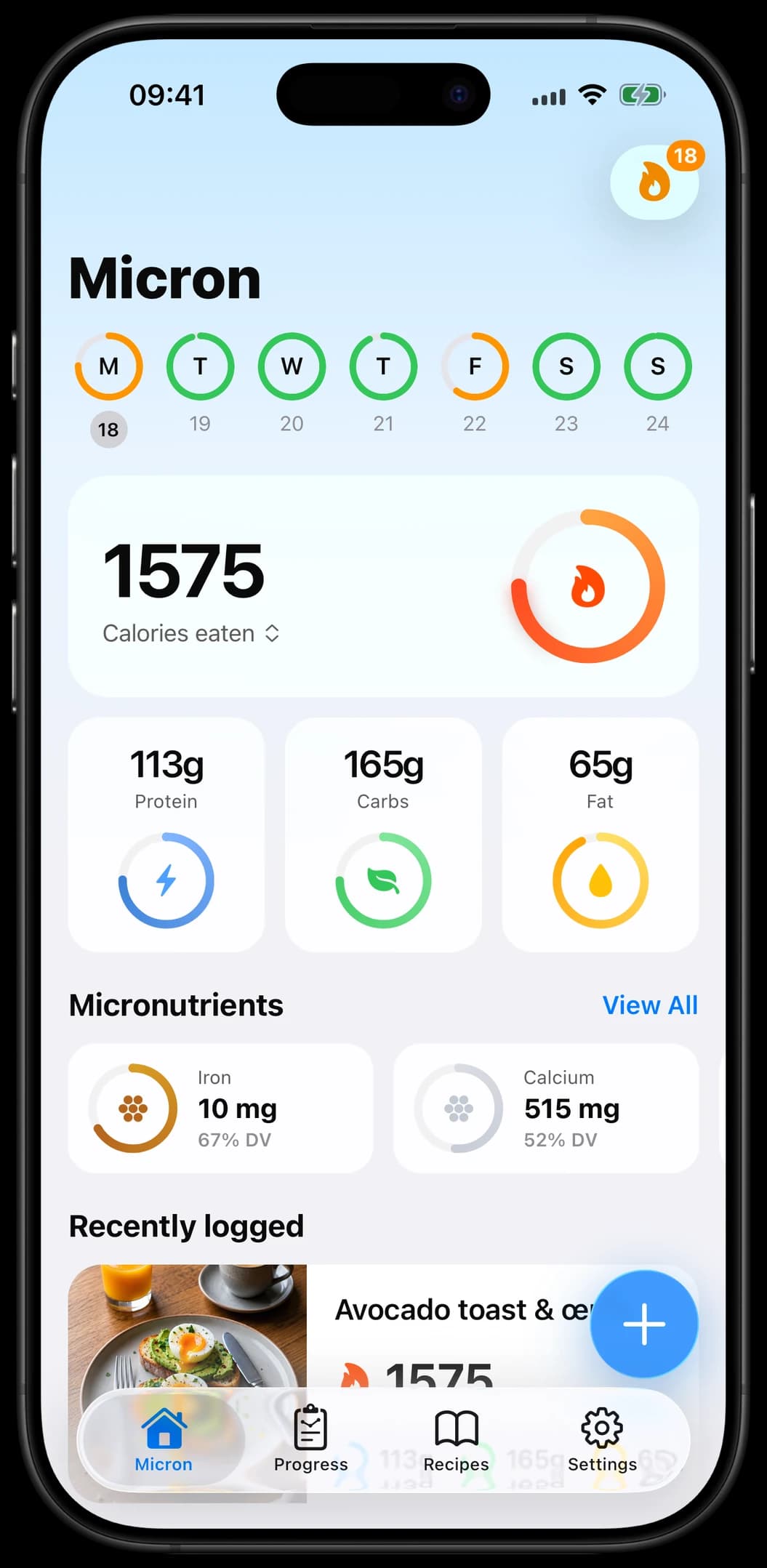
Using a calorie tracking app (like Micron) is the most effective way to stay within your goal. We tend to overestimate expenditure and underestimate intake without a measuring tool.

Add strength training

Resistance training during a deficit preserves and builds muscle mass, improving body composition and keeping your metabolism active — avoiding metabolic slowdown.

Sleep enough

Lack of sleep disrupts hunger hormones (ghrelin and leptin) and increases cravings, particularly for sweet and fatty foods. 7–9 hours per night optimizes fat loss.

Frequently asked questions about calorie deficit

Pour aller plus loin

Track your calorie deficit daily

Ultra-fast barcode scan · Micronutrient tracking · Detailed stats · 150,000+ satisfied users

Discover Micron for free
Micron — Calorie Deficit Calculator — Free & Accurate Tool