
Muscle building: program, menu and 12-week plan
This guide is the practical protocol: calculation steps, training program, numeric menu (male/female/vegetarian), 12-week cycle timeline, and the mistakes specific to training. For the theory of caloric surplus (lean vs dirty bulk, muscle/fat ratio), see the dedicated guide.

By Adrien Grusse · Founder of Micron
Published April 28, 2026 · 14 min read
Contents
Muscle building is the phase of a lifting cycle during which you aim to gain muscle mass. It rests on three inseparable pillars: a moderate caloric surplus, a progressive overload resistance program, and adequate recovery (sleep, protein, stress management).
This guide is intentionally protocol-focused — it gives you the execution plan. For the underlying theory (surplus mechanism, realistic muscle/fat ratio, lean bulk vs dirty bulk, female specifics, duration), refer to the caloric surplus guide. To compute your needs automatically, use the caloric surplus calculator.
1. Prerequisites: are you ready for a bulk?
Starting a bulk without the right foundations mostly produces fat. Three non-negotiable prerequisites:
Prerequisite 1: a structured resistance program
You should be training 3 to 5 times per week in the gym (free weights + machines), with a structured program that follows progressive overload principles. Without this, the surplus mostly turns into fat. If you're new to lifting, start with 2-3 months of a simple program at maintenance before switching to a bulk.
Prerequisite 2: a reasonable starting body fat %
Ideally, men start a bulk at 10-15 % body fat and women at 18-22 %. That is the optimal window: above it (men > 18 %, women > 25 %), returns get worse and a growing share of the surplus goes to fat — better to run a mini-cut first to bring it down before switching to a bulk. Keep that separate from the higher not-indicated threshold (> 22 % for men, > 30 % for women), beyond which a strict bulk simply isn't the right protocol.
Prerequisite 3: managed sleep and stress
Muscle synthesis peaks during deep sleep. If you're sleeping < 7 h per night or running on chronic high stress (elevated cortisol), no surplus will compensate — muscle gain will be poor and fat gain significant. Put these fundamentals in place first.
Not recommended for
Strict bulking is not appropriate for: (a) overweight individuals (> 22 % body fat for men, > 30 % for women) — prefer a moderate deficit, (b) complete beginners (< 3 months of lifting) — prefer maintenance, (c) people in chronic under-eating — first normalize via a reverse diet, (d) athletes in competition season (weight-class sports).
2. Compute your bulking calories in 4 steps
The general formula: a 10 to 20 % surplus over your TDEE (Total Daily Energy Expenditure). In practice, +200 to +500 kcal/day depending on your level and metabolism.
Step-by-step method
- Compute your BMR (basal metabolic rate) with the Mifflin-St Jeor formula: Men: (10 × weight kg) + (6.25 × height cm) − (5 × age) + 5. Women: (10 × weight kg) + (6.25 × height cm) − (5 × age) − 161.
- Multiply by your activity coefficient: 1.375 (sedentary with lifting 3×/week), 1.55 (moderate, lifting 4-5×/week), 1.725 (very active, lifting + sport or physical job).
- Add 10-20 % to that TDEE based on your goal: +10 % for a strict lean bulk (advanced), +15 % for a standard bulk (intermediate), +20 % for a faster bulk (beginners or ectomorphs).
- Verify on the scale for 2 weeks: aim for +0.3 to +0.5 kg/week. If more, cut 100 kcal. If less (stalled), add 100 kcal.
Skip the manual math
Our caloric surplus calculator integrates all of these steps plus automatic macro distribution. Enter your age, height, weight, sex, activity level and goal — you get your calorie target and macros in 30 seconds.
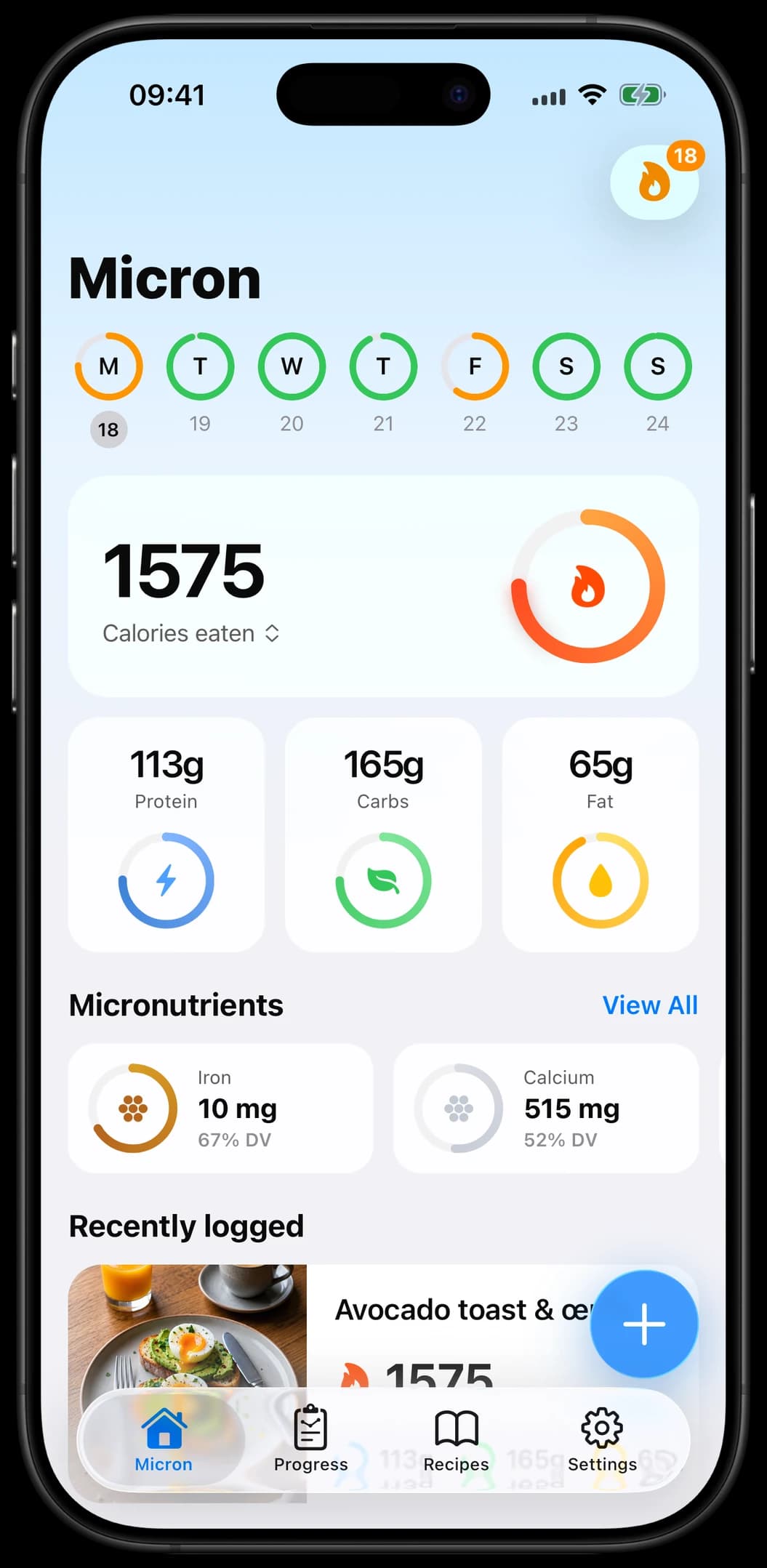
Track your calories from a photo.
Snap a photo of your meal: calories, macros and 30+ micronutrients, calculated instantly.


3. Macro distribution for muscle building
The optimal split, validated by the literature, for a lifter on a bulk:
Protein: 1.8 to 2.2 g per kg of body weight
This is the central macronutrient — it provides the amino acids essential for muscle synthesis. At 75 kg, that's 135-165 g/day, split across 4-5 doses (each 30-50 g dose stimulates synthesis for 3-4 h). Priority sources: lean meats (chicken, 5% lean ground beef, turkey), fish (salmon, cod, tuna), eggs, dairy (skyr (Icelandic-style yogurt), fromage blanc, whey as a supplement).
Carbs: 4 to 6 g per kg of body weight
Carbs are the primary fuel for training and recovery. At 75 kg, aim for 300-450 g/day. Priority sources: rice, pasta, sweet potato, potatoes, oats, fruit, legumes. Concentrate part of the intake around training (before and after) to optimize performance and recovery.
Fats: 0.8 to 1.2 g per kg of body weight
Fats are essential for hormone production (testosterone in particular) and absorption of fat-soluble vitamins (A, D, E, K). At 75 kg, aim for 60-90 g/day. Priority sources: olive oil, avocado, nuts (almonds, walnuts), fatty fish, egg yolks.
Worked example for 75 kg, +400 kcal/day surplus (TDEE 2,800 → target 3,200 kcal)
Protein: 165 g (660 kcal) · Fats: 85 g (765 kcal) · Carbs: 445 g (1,780 kcal). That's ~3,200 kcal, and all three macros stay inside the ranges above: 2.2 g/kg protein, 1.1 g/kg fats, 5.9 g/kg carbs.
5. The training program
Without an appropriate training program, the surplus mostly turns into fat. Three principles structure a good muscle-building program.
Principle 1: progressive overload
Your loads should increase regularly. If you're squatting the same bar for 8 reps for 6 months, your body has no reason to build muscle. Aim for +1.25-2.5 kg every 1-2 weeks on the main compound lifts (squat, deadlift, bench press, pull-ups), or +1 rep at the same load. Log every session — without tracking, you won't know if you're progressing.
Principle 2: frequency per muscle group
Each muscle group should be trained 2× per week to maximize protein synthesis (Schoenfeld 2016)[2]. Three common splits:
- 4 sessions/week — Upper/Lower: Monday (upper A), Tuesday (lower A), Thursday (upper B), Friday (lower B). Ideal beginner to intermediate.
- 5 sessions/week — Push/Pull/Legs (PPL): Monday (push: chest/shoulders/triceps), Tuesday (pull: back/biceps), Wednesday (legs: quads/hamstrings/abs), Friday (push), Saturday (pull). Ideal intermediate.
- 6 sessions/week — PPL ×2: Monday-Wednesday-Friday (push/pull/legs A), Tuesday-Thursday-Saturday (push/pull/legs B). Reserved for advanced lifters with strong recovery.
Principle 3: weekly volume
Optimal volume per muscle group is 10-20 sets/week for an intermediate (Schoenfeld 2017)[3]. Below that, the stimulus is insufficient for growth. Beyond it, recovery becomes the limiting factor. In practice: 3-4 exercises × 3-4 sets × 6-12 reps, per muscle group per week.
Compound lifts first
60-70 % of your volume should come from compound movements (squat, deadlift, bench press, overhead press, pull-ups, row). They recruit a lot of muscle mass at once and trigger a stronger hormonal response (testosterone, GH) than isolation exercises.
A sample Upper/Lower week (intermediate, 75 kg)
- Monday — Upper A: Bench press 4×6-8 · Pull-ups 4×8-10 · Overhead press 3×8 · Barbell row 3×10 · Barbell curl 3×12 · Triceps cable extensions 3×12.
- Tuesday — Lower A: Squat 4×6-8 · Romanian deadlift 3×8 · Leg press 3×10 · Leg curl 3×12 · Standing calf raises 4×15.
- Wednesday — Rest / light cardio 30 min.
- Thursday — Upper B: Incline bench 4×8-10 · Lat pulldown 4×8-10 · Lateral raises 3×12 · Seated row 3×12 · Hammer curl 3×12 · Dips or push-ups 3×AMRAP.
- Friday — Lower B: Deadlift 4×4-6 · Front squat 3×8 · Lunges 3×10/leg · Leg extension 3×12 · Seated calf raises 4×15 · Abs 3×15.
- Saturday-Sunday — Rest (with 8,000-10,000 steps/day if possible for active recovery).
6. What a 12-week cycle looks like
A well-run bulk follows a predictable trajectory. Here's what to expect week by week for an intermediate at 75 kg, +400 kcal/day surplus, Upper/Lower 4×/week. To understand how this duration varies by level (beginner, intermediate, advanced) and when to stop the bulk, see the caloric surplus guide.
Which split should you choose?
Comparison of the two most effective splits for muscle building.
| Upper/Lower (4×/week) | Push/Pull/Legs (5-6×/week) | |
|---|---|---|
| Frequency per muscle | 2× per week | 2× per week |
| Suitable level⭐ | Beginner to intermediate | Intermediate to advanced |
| Session length | 60-75 min | 50-70 min |
| Recovery | Good (3 days off) | More demanding |
| Possible weekly volume | 10-15 sets/muscle | 15-25 sets/muscle |
| Main advantage | Simple, time-efficient | Max volume, specialization |
| Recommended for | The vast majority of lifters | Advanced, hypertrophy athletes |
Bulking cycle — 12-week projection
Typical trajectory for an intermediate at 75 kg, +400 kcal/day surplus, 4 sessions/week. Values are averages — individual variation depends on genetics, sleep, stress, adherence.
| Level | Per week | Per month | For 5 kg | Recommendation |
|---|---|---|---|---|
| Weeks 1-4 | +0.5 kg / week | +2 kg over the month | 75 → 77 kg | Metabolic wake-up phase: water and glycogen. Adjust kcal if > +0.7 kg/week. |
| Weeks 5-8 | +0.3 to 0.5 kg / week | +1.5 kg over the month | 77 → 78.5 kg | Nominal phase. Gym loads climbing strongly (+5-10 kg on the main lifts). Waist stable. |
| Weeks 9-12 | +0.2 to 0.4 kg / week | +1.3 kg over the month | 78.5 → 80 kg | Plateau possible. Watch body fat % and waist — switch to a mini-cut if > 18 % body fat (men) or > 3 weeks of stagnation. |
| 12-week summary | +5 kg total | ~2.5 kg muscle / 2.5 kg fat | Loads +10-15 % on main lifts | 4-6 week mini-cut at -20 % TDEE to bring body fat % down before relaunching. |
5 training-specific mistakes during a bulk
Mistakes specific to executing the program — distinct from the generic nutrition pitfalls covered in the caloric surplus guide.
📈Loads that don't go up (no progressive overload)
If your loads stay the same over 8-12 weeks, your body has no reason to build muscle. Log every session with an app or notebook: weight, reps, RIR (reps in reserve). Without tracking, you stagnate without realizing it. Aim for +1.25-2.5 kg every 1-2 weeks on the main lifts or +1 rep at the same load.
🦵Skipping legs or compound lifts
The squat, deadlift and bench press trigger a hormonal response (testosterone, GH) that benefits the entire muscle mass — not just the muscles being trained. Skipping legs to only train chest/biceps massively reduces the program's anabolic potential. At minimum, 2 leg sessions per week, with one heavy compound movement.
📉Weekly volume too low (< 10 sets/muscle)
Many beginners string together 1-2 sets of one exercise, move to another, and end up at 6-8 weekly sets per muscle. That's insufficient for hypertrophy in a surplus (Schoenfeld 2017)[3]. Count your effective sets per muscle group across the week — aim for 10-20 for the larger groups (legs, back, chest), 8-15 for the smaller ones (arms, rear delts, calves).
🏃Too much cardio in parallel
Heavy doses of intense cardio (HIIT, long-distance running) during a bulk eat into your muscle-recovery capacity and raise calorie needs with no aesthetic benefit. Limit to 1-2 sessions of moderate cardio (zone 2 — bike, brisk walking, light rower) of 30 min/week for cardiovascular health. The rest of your expenditure should come from daily walking (NEAT).
⏰Poor protein timing through the day
Cramming 150 g of protein into 2 doses (lunch + dinner) saturates synthesis only once — the rest of the day, the body sits in neutral nitrogen balance. Better to split into 4-5 doses of 30-50 g spaced 3-4 h apart to stimulate synthesis continuously (Schoenfeld 2018)[5]. A post-workout whey and a pre-bed fromage blanc fill the gaps easily.
Track your bulk from a photo.
Get your calorie target and personalized macros in 30 seconds.
Disclaimer
This article is for information only and does not replace medical advice. Needs vary with age, sex and situation (pregnancy, conditions, medication): if in doubt or symptomatic, talk to a health professional.
Frequently asked questions
How do I gain muscle quickly?
There's no healthy shortcut. Muscle gain is biologically capped at 0.5-1 kg/month for a beginner and 0.2-0.4 kg/month for an intermediate (Helms 2014)[1]. Trying to go faster via a dirty bulk (+1,000 kcal/day) mostly produces fat that you'll have to lose later. The optimal « fast » is a lean bulk at +400 kcal/day with 4-5 lifting sessions/week and strict progressive overload.
How many calories to gain muscle?
TDEE + 200 to +500 kcal/day, depending on your level and metabolism. For a 75 kg male with a TDEE of 2,800 kcal, plan on 3,000-3,200 kcal/day. For a 60 kg female with a TDEE of 2,100 kcal, 2,250-2,400 kcal/day. Watch the scale: aim for +0.3-0.5 kg/week. Faster = too much fat.
What lifting program for muscle building?
For most lifters, an Upper/Lower 4×/week or a Push/Pull/Legs 5-6×/week. Each muscle group trained 2× per week, 10-20 weekly sets, focus on compound movements (squat, deadlift, bench press, pull-ups). Progressive overload is mandatory: +1.25 to 2.5 kg every 1-2 weeks on the main lifts.
How much protein for muscle building?
1.8 to 2.2 g per kg of body weight. At 75 kg: 135-165 g/day, split across 4-5 doses of 30-50 g spaced 3-4 h apart. Beyond 2.2 g/kg, the meta-analysis by Morton et al. (2018)[6] shows no further benefit on muscle mass gain; the review by Schoenfeld and Aragon (2018)[5] puts the per-meal saturation threshold at around 0.4 g/kg.
How many times per week to train for muscle gain?
3 sessions minimum (full-body), 4-5 sessions optimal (Upper/Lower or PPL). Beyond 6 sessions/week, recovery becomes the limiting factor — except for very advanced athletes. Frequency per muscle (2×/week) matters more than total session count.
What weekly set volume to target?
10-20 effective sets per muscle group per week for an intermediate (Schoenfeld 2017)[3]. In practice: 3-4 exercises × 3-4 sets × 6-12 reps. Larger groups (legs, back, chest) handle the upper end (15-20). Smaller groups (arms, rear delts, calves) are fine at 8-15.
Should I do cardio during a bulk?
Yes, but limited. 1-2 sessions of moderate cardio (30 min, zone 2 — bike, brisk walking, light rower) per week preserve cardiovascular health and don't compromise muscle recovery. Avoid excessive HIIT and long endurance sessions that raise calorie needs and impair muscle synthesis.
Bulking menu: how many meals per day?
4 to 5 meals in general. Advantage: spread protein across 30-50 g doses 3-4 h apart to stimulate synthesis continuously. At 3,200 kcal/day, 5 meals of 600-800 kcal are easier to digest than 3 meals of 1,100 kcal. If you have low appetite, add shakes (whey + whole milk + oats + peanut butter) which deliver 600-700 dense kcal without overfilling the stomach.
Can you build muscle as a vegetarian or vegan?
Yes, no problem at all — muscle synthesis doesn't depend on whether protein is animal- or plant-based, but on total quantity and the essential amino acid profile (especially leucine ≥ 2.5 g/dose). Mix sources: tofu/tempeh, legumes, seitan, eggs/dairy (if vegetarian), whey or pea isolate. Aim for 2.0-2.2 g/kg (slightly higher than for omnivores to compensate for a less optimal amino acid profile).
What supplements for muscle building?
Three supplements have a solid scientific basis: (1) whey as a complement if dietary protein intake is insufficient — no magic, just convenience, (2) creatine monohydrate at 3-5 g/day — significant strength and hypertrophy gains (Kreider 2017)[7], (3) vitamin D3 if deficient (often the case in winter at northern latitudes). The rest is optional or ineffective.
What if I'm not gaining weight despite the surplus?
Three typical causes. (1) Underestimated TDEE — your expenditure is higher than projected: add 200 kcal/day and observe 2 weeks. (2) Overestimated intake — weigh your food for one week to verify: this is the most common cause. (3) High unconscious NEAT — you move more than expected: add 250 kcal/day. If stagnation persists after these 3 adjustments over 4-6 weeks, see a coach.
When to switch from bulking to cutting?
Four signals indicate it's time to switch to a mini-cut or full cut: (1) body fat % > 18 % (men) or > 25 % (women), (2) waist circumference growing faster than arm/thigh measurements, (3) performance stalled for 4-6 weeks, (4) drop in energy/sleep quality. Then start a 4-6 week mini-cut at -20 % of TDEE, then relaunch a bulk if conditions are right.
Difference between muscle building and weight gain?
Muscle building targets muscle (+ unavoidable bit of fat) via moderate caloric surplus + resistance training. Weight gain alone ignores composition: you can put on weight purely as fat without muscling up. For an aesthetic, athletic, or health goal, you always want muscle building — never raw weight gain.
Scientific sources
This article draws on 7 peer-reviewed studies and publications, listed below. Every link points to the original source (PubMed, NIH, government agencies, scientific journals).
- [1]Helms ER, Aragon AA, Fitschen PJ (2014). Evidence-based recommendations for natural bodybuilding contest preparation: nutrition and supplementation. Journal of the International Society of Sports Nutrition. View source ↗PMID: 24864135
- [2]Schoenfeld BJ, Ogborn D, Krieger JW (2016). Effects of resistance training frequency on measures of muscle hypertrophy: a systematic review and meta-analysis. Sports Medicine. View source ↗PMID: 27102172
- [3]Schoenfeld BJ, Ogborn D, Krieger JW (2017). Dose-response relationship between weekly resistance training volume and increases in muscle mass: a systematic review and meta-analysis. Journal of Sports Sciences. View source ↗PMID: 27433992
- [4]Dattilo M, Antunes HK, Medeiros A, et al. (2011). Sleep and muscle recovery: endocrinological and molecular basis for a new and promising hypothesis. Medical Hypotheses. View source ↗PMID: 21550729
- [5]Schoenfeld BJ, Aragon AA (2018). How much protein can the body use in a single meal for muscle-building? Implications for daily protein distribution. Journal of the International Society of Sports Nutrition. View source ↗PMID: 29497353
- [6]Morton RW, Murphy KT, McKellar SR, et al. (2018). A systematic review, meta-analysis and meta-regression of the effect of protein supplementation on resistance training-induced gains in muscle mass and strength in healthy adults. British Journal of Sports Medicine. View source ↗PMID: 28698222
- [7]Kreider RB, Kalman DS, Antonio J, et al. (2017). International Society of Sports Nutrition position stand: safety and efficacy of creatine supplementation in exercise, sport, and medicine. Journal of the International Society of Sports Nutrition. View source ↗PMID: 28615996

About the author
Adrien Grusse
Founder of Micron
Adrien is the founder of Micron, the app that helps more than 150,000 users track their micronutrients daily. Before Micron, he worked on the Growth team at Finary (Y Combinator). Adrien is not a credentialed dietitian — his role here is to translate the scientific literature into accessible content, rigorously. Every article cites peer-reviewed sources (PubMed, Cochrane, recent meta-analyses); no claim is made without a verifiable reference. For individual medical follow-up, consult a healthcare professional.