

Personne courant sur une colline au coucher du soleil
TrainingSourced · Mifflin-St Jeor formula

Caloric surplus calculator

Get your daily calorie target and macros in seconds for effective muscle gain, tailored to your level.

Photo de Adrien Grusse

By Adrien Grusse · Founder of Micron

Published April 27, 2026 · Updated April 28, 2026

Your information

Sex
yrs
cm
kg
Activity level
Surplus type

The recommended approach for most lifters: clean muscle gain with an optimized muscle-to-fat ratio.

Strength training experience

Enter your age, height and weight

to get your muscle-gain calorie target

How does the calculation work?

Step 01

Basal Metabolic Rate (BMR)

The Mifflin-St Jeor formula, considered the most accurate by current scientific literature. It calculates your minimum calorie needs at rest from your sex, age, height and weight.

Step 02

Total Daily Energy Expenditure (TDEE)

We multiply your BMR by a physical activity coefficient (1.2 to 1.9) to estimate your actual daily calorie expenditure. This is your maintenance threshold.

Step 03

Calibrated surplus + macros

We apply a surplus of +10%, +15% or +20% depending on the mode you chose. Macros are calibrated for muscle gain: protein at 2.0 g/kg, fat at 28%, carbs as the remainder.

What is a caloric surplus?

A caloric surplus is the opposite of a deficit: you eat more calories than your body burns. Combined with resistance training and adequate protein intake, this surplus provides the energy needed for muscle protein synthesis — the physiological foundation of any muscle-gain phase.

The key isn't to eat "a lot," but to eat "just enough" to maximize muscle gain while limiting fat gain. A moderate surplus of 200–400 kcal/day is enough for most lifters.

Pour comprendre en détail — lean bulk vs dirty bulk, ratio muscle/gras réaliste selon le niveau, quand arrêter, spécificités femmes, pièges à éviter et 12 questions fréquentes : lire le guide complet sur le surplus calorique →

What muscle-to-fat ratio can you expect?

Whatever the size of your surplus, your body can only build 0.2 to 0.5 kg of muscle per month on average (Helms et al., 2014). Any extra calories not used for muscle protein synthesis are stored as fat. That's why calibrating matters.

4 tips to optimize your muscle gain

01

Aim for 2.0 g/kg of protein

Spread across 4 servings of 30–40 g, 3–4 hours apart. Beyond 2.2 g/kg, studies show no additional benefit.

02

Progress in the gym

A surplus only makes sense paired with progressive overload. Your loads and/or volume must increase over 8–12 weeks, otherwise the surplus turns into fat.

03

Sleep 7–9 hours

Muscle protein synthesis peaks during sleep. Truncated sleep (< 6 h) reduces protein synthesis by 18% (Dattilo et al., 2011).

04

Weigh yourself weekly

Always under the same conditions (fasted, in the morning). If you gain more than 0.7 kg/week, cut the surplus by 100–150 kcal. If you stall for 2 weeks, add 100 kcal.

Frequently asked questions about caloric surplus

Sources scientifiques

This article draws on 7 peer-reviewed studies and publications, listed below. Every link points to the original source (PubMed, NIH, government agencies, scientific journals).

  1. [1]Helms ER, Aragon AA, Fitschen PJ (2014). Evidence-based recommendations for natural bodybuilding contest preparation: nutrition and supplementation. Journal of the International Society of Sports Nutrition. View source ↗PMID : 24864135
  2. [2]Schoenfeld BJ, Aragon AA (2018). How much protein can the body use in a single meal for muscle-building? Implications for daily protein distribution. Journal of the International Society of Sports Nutrition. View source ↗PMID : 29497353
  3. [3]Iraki J, Fitschen P, Espinar S, Helms E (2019). Nutrition recommendations for bodybuilders in the off-season: a narrative review. Sports (Basel). View source ↗PMID : 31247944
  4. [4]Dattilo M, Antunes HK, Medeiros A, et al. (2011). Sleep and muscle recovery: endocrinological and molecular basis for a new and promising hypothesis. Medical Hypotheses. View source ↗PMID : 21550729
  5. [5]Phillips SM, Van Loon LJ (2011). Dietary protein for athletes: from requirements to optimum adaptation. Journal of Sports Sciences. View source ↗PMID : 22150425
  6. [6]Morton RW, Murphy KT, McKellar SR, et al. (2018). A systematic review, meta-analysis and meta-regression of the effect of protein supplementation on resistance training-induced gains in muscle mass and strength in healthy adults. British Journal of Sports Medicine. View source ↗PMID : 28698222
  7. [7]Garthe I, Raastad T, Refsnes PE, et al. (2013). Effect of nutritional intervention on body composition and performance in elite athletes. European Journal of Sport Science. View source ↗PMID : 23574396
Photo de Adrien Grusse

About the author

Adrien Grusse

Founder of Micron

Adrien is the founder of Micron, the app that helps more than 150,000 users track their micronutrients daily. Before Micron, he worked on the Growth team at Finary (Y Combinator). Adrien is not a credentialed dietitian — his role here is to translate the scientific literature into accessible content, rigorously. Every article cites peer-reviewed sources (PubMed, Cochrane, recent meta-analyses); no claim is made without a verifiable reference. For individual medical follow-up, consult a healthcare professional.

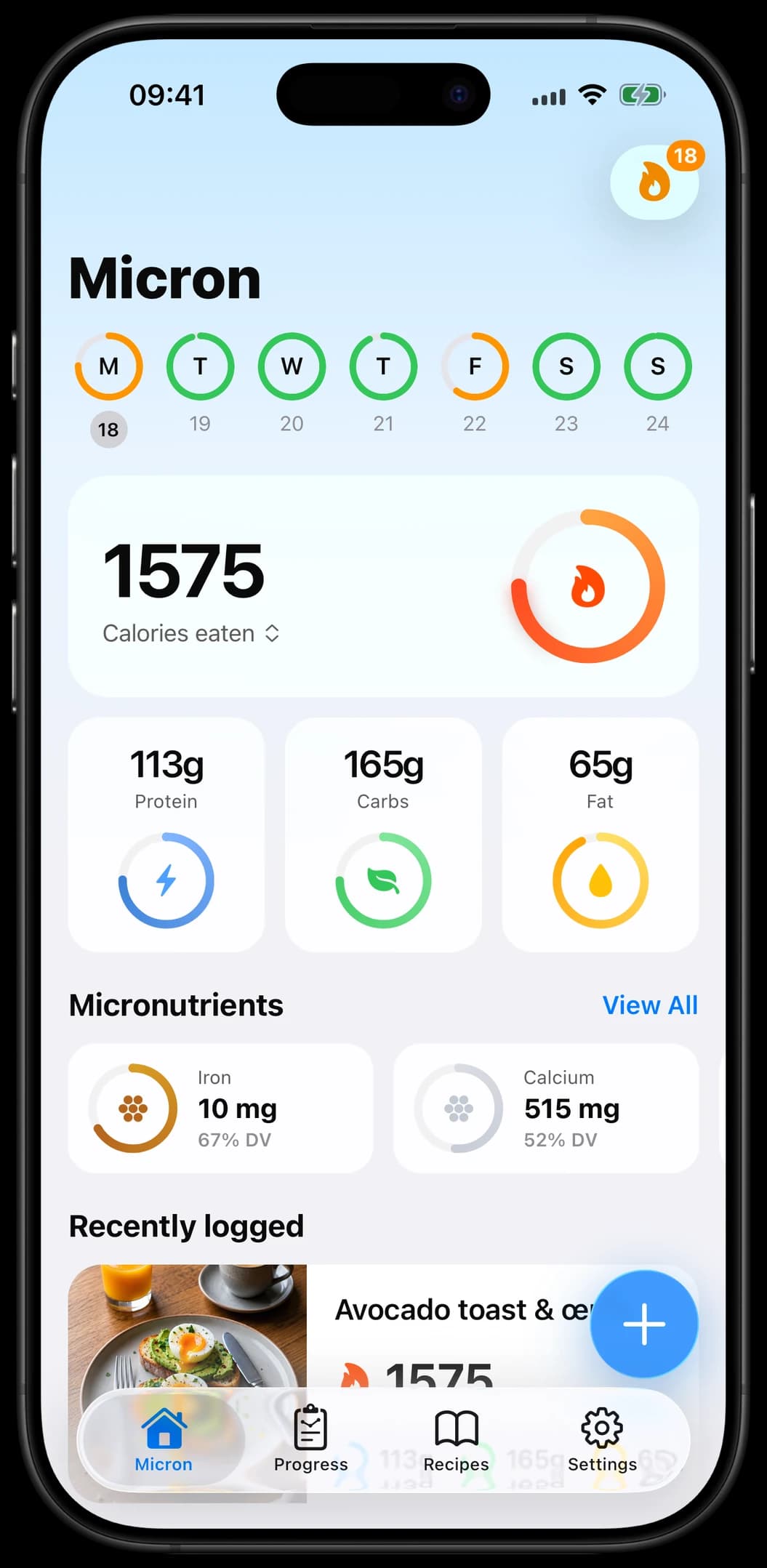
Track your muscle gain every day

Ultra-fast scan · Protein + micronutrient tracking · Detailed stats · 150,000+ users

Discover Micron for free
Micron — Calcul Surplus Calorique — Outil Gratuit Prise de Masse