
Caloric surplus & lean bulk: evidence-based guide to muscle gain
Gaining muscle isn't just about eating « more ». Past a certain surplus, muscle no longer keeps up and fat absorbs the difference. This guide explains how much to aim for, how to structure your bulk, and when to stop.

By Adrien Grusse · Founder of Micron
Published April 27, 2026 · Updated June 14, 2026 · 11 min read
Contents
- 1. 1. Definition and mechanism
- 2. 2. How much surplus to aim for?
- 3. 3. Lean bulk vs dirty bulk: the real controversy
- 4. 4. Realistic muscle/fat ratio: what to expect
- 5. 5. Bulk duration and when to stop
- 6. 6. Caloric surplus for women: what changes
- 7. 7. Transition to cutting: the mini-cut
- Frequently asked questions
- Scientific sources
A caloric surplus occurs when you consume more calories than your body expends. Combined with resistance training and adequate protein intake, this surplus provides the energy and substrates required for muscle synthesis — the physiological basis of any muscle-gain phase.
But unlike a deficit (where the body draws on fat reserves), a surplus is trickier to manage: too much excess does not linearly increase muscle gain — it ends up as fat storage. The goal is therefore the minimum surplus that maximizes muscle gain — a precise balance that depends on your level, your genetics, and your goals.
1. Definition and mechanism
A caloric surplus is the positive difference between your intake and your Total Daily Energy Expenditure (TDEE). If your TDEE is 2,800 kcal/day and you consume 3,100 kcal, you are running a 300 kcal surplus.
Physiologically, this surplus provides two essentials for muscle gain: (1) the energy needed for intense training (you recover better and progress faster), (2) the substrates (carbs, fats, protein) the body uses to rebuild larger muscle fibers after each session. Without a surplus, muscle synthesis is limited — you can progress slightly at maintenance, but not optimally.
Biological ceiling on muscle growth
No matter the surplus, the body can synthesize on average only 0.2-0.5 kg of muscle per month (Helms et al., 2014)[1]. Beginners can flirt with 0.5-1 kg/month over their first months. Beyond that, excess surplus ends up as fat storage — hence the importance of calibration.
2. How much surplus to aim for?
The most common recommendation is a surplus of 10 % to 20 % of TDEE for a novice or intermediate lifter — in practice 200 to 500 kcal/day — and only 5 to 10 % for an advanced one[3]. Beyond that, muscle no longer keeps up and the share of fat in the weight gained increases.
The 200-300 kcal evidence-based recommendation
For most natural lifters running a lean bulk, peer-reviewed research converges on a 200-300 kcal/day surplus as the optimal range — Iraki, Fitschen, Espinar & Helms (2019)[3] recommend a moderate surplus for off-season bodybuilders (+10-20 % above maintenance for novice and intermediate lifters, +5-10 % for advanced), which lands in this window for most people. It maximizes muscle synthesis without the fat-gain penalty seen with larger surpluses, and stays sustainable over 12+ weeks.
By experience level
- Beginner (< 12 months of lifting): a 200-400 kcal/day surplus is enough. Your body is highly responsive, and you can gain 0.5-1 kg of muscle per month with a moderate surplus.
- Intermediate (1-3 years): 250-400 kcal/day surplus. The muscle-gain rate slows (0.2-0.4 kg/month), and a larger surplus no longer yields proportional gains.
- Advanced (> 3 years): 150-300 kcal/day surplus, sometimes less. At this stage, slow lean gain beats large bulks. Many advanced athletes alternate maintenance and mini-surpluses.
Practical calibration
Weigh yourself every morning fasted for one week. If your weight is stable, your TDEE is correct. Add 250 kcal/day as a starting point. Watch the trend over 2-3 weeks: if you gain 0.3-0.5 kg/week, the surplus is right. If > 0.7 kg/week, cut 100 kcal. If stalled, add 100 kcal.
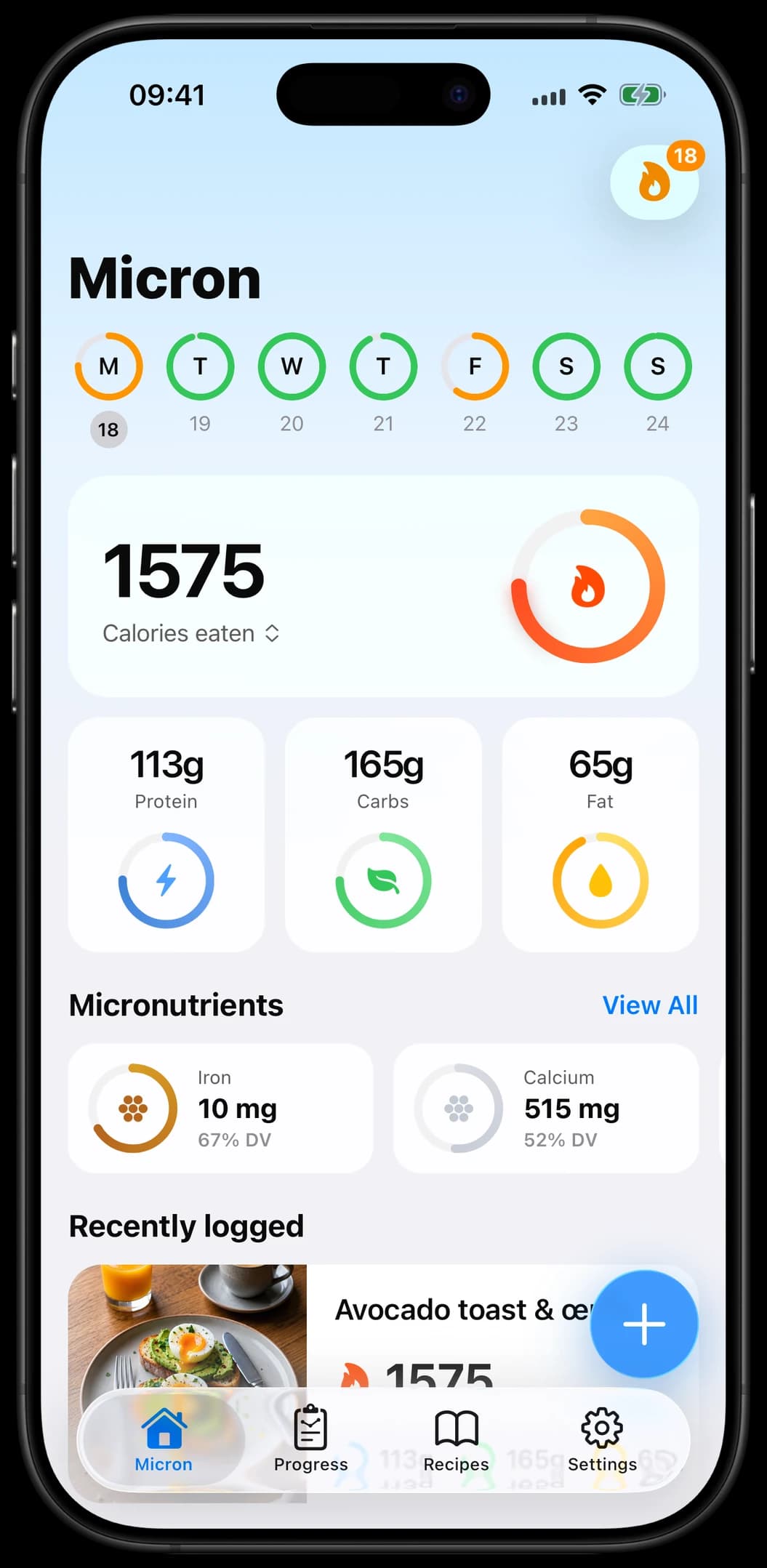
Track your calories from a photo.
Snap a photo of your meal: calories, macros and 30+ micronutrients, calculated instantly.


3. Lean bulk vs dirty bulk: the real controversy
Two schools have been at odds for 30 years in lifting culture. The practical difference is huge.
Dirty bulk
Large surplus (+500 to +1,000 kcal/day), often little qualitative control — the idea being to provide « lots of everything » to maximize muscle gain. Popular in the 90s-2000s, especially among young men in hypertrophy phases. Its limit is physiological: muscle synthesis is capped (0.2 to 0.5 kg/month on average, more in a beginner)[1], and the excess muscle cannot use is stored as fat. The larger the surplus, the greater the share of fat in the weight gained.
Lean bulk
Moderate surplus (+200 to +400 kcal/day), strict macro tracking, focus on food quality (lightly processed foods). Dominant approach among modern natural athletes, supported by the scientific literature[3]. The gain is slower but far « cleaner »: by staying close to the minimum surplus that supports progression, you limit the share of fat in the weight gained.
Scientific verdict
The narrative review by Iraki et al. (2019)[3] recommends a moderate surplus — +10 to 20 % above maintenance for a novice or intermediate lifter, and only +5 to 10 % for an advanced one — for a weight gain in the region of 0.25 to 0.5 % of body weight per week. The expected benefit: less fat to lose afterwards during the cut, performance preserved, superior sustainability. Dirty bulk retains value only for those who genuinely struggle to reach the minimum surplus.
4. Realistic muscle/fat ratio: what to expect
This is the taboo question — what nobody says. The figures below are orders of magnitude, not measured constants: the split between muscle and fat varies widely from one person to another. What is solid is the trend — it degrades as your level rises and as the surplus grows.
For 1 kg gained, how much is muscle?
- Beginner on lean bulk: 60-70 % muscle, 30-40 % fat. Gains are impressive in the first year — the « newbie gains period ».
- Intermediate on lean bulk: 40-50 % muscle, 50-60 % fat. The margin narrows. A 5 kg gain over 3 months = 2-2.5 kg of muscle if everything is optimized.
- Advanced on lean bulk: 25-35 % muscle, 65-75 % fat. At this stage, surplus diminishing returns kick in. Better to run short cycles (8 weeks) with mini-cuts in between.
- Any level on dirty bulk: 20-35 % muscle, 65-80 % fat. The ratio degrades severely.
5. Bulk duration and when to stop
A bulk isn't a permanent state — it's a phase. Optimal duration depends on your starting composition and your tolerance.
- Beginner: 3-6 consecutive months. Newbie gains carry a long bulk without excess fat. Beyond that, the ratio degrades.
- Intermediate: cycles of 8-16 weeks. Alternate with 4-6 week mini-cuts to bring body fat down before relaunching a bulk.
- Advanced: short cycles of 6-10 weeks, with more frequent mini-cuts. Muscle gain will be slow but clean.
Stop signals to watch
- Body fat %: men > 18 % (15 % ideal), women > 25 %. Above that, insulin sensitivity degrades and muscle gain slows.
- Waist circumference: if your waist is growing faster than your arm/thigh measurements, you're gaining too much fat.
- Energy/sleep: feeling « heavy », short of breath, sleep degrading — your body is signaling it's time to switch to a cut.
- Performance: if your gym performance has stalled for 4-6 weeks despite the surplus, adding more calories isn't the answer. It's likely rest or programming you're missing.
6. Caloric surplus for women: what changes
Caloric surplus works the same way in women — muscle synthesis physiology is identical. But a few specifics deserve to be anticipated.
Different fat-storage sensitivity
Women store fat more easily (especially in the hip/thigh area) due to estrogen. An identical surplus as a percentage of TDEE will produce slightly more fat in women than in men with an equivalent profile. Practical takeaway: aim for 10-15 % of TDEE in surplus (vs 15-20 % for men).
Unfounded fears
Many women fear « becoming too muscular ». This is physiologically very difficult without a specific multi-year program (and often hormonal assistance). A woman eating in a moderate surplus and lifting 3-4× per week gains on average 2-4 kg of muscle over 12 months — which translates visually into a more toned body, never « bodybuilder-like ».
Hormonal cycle
As with a deficit, the cycle influences water retention. Always weigh in at the same phase of the cycle (ideally early, post-period) for comparisons. Weekly fluctuations can reach ±2 kg without meaning real fat or muscle gain.
7. Transition to cutting: the mini-cut
After a bulk, you want to lower the body fat gained to reveal the muscle you built. That's the « cut » or « shred » phase. Rather than abruptly switching to a heavy deficit, the modern approach favors the mini-cut.
- Mini-cut: 20-25 % deficit of TDEE for 4-6 weeks. Enough to lose 2-4 kg of fat, with no risk of muscle loss (recent muscle memory protects you).
- Macro maintenance: high protein (2.0-2.5 g/kg), strength training kept at intensity (lower volume if fatigue rises).
- Bulk relaunch: after 4-6 weeks of mini-cut, recompute your TDEE (your weight has changed) and start a new surplus cycle.
Short cycles > long cycles
Lifters who alternate 12-week bulks + 4-6 week mini-cuts generally progress better long term than those who run 9-month continuous bulks followed by 3 months of harsh cutting. Slow clean yo-yo beats extreme transformation.
Lean bulk vs dirty bulk: comparison
Numbers correspond to an intermediate lifter (1-3 years of regular training).
| Lean bulk | Dirty bulk | |
|---|---|---|
| Caloric surplus⭐ | +200 to +400 kcal/day (10-20 % TDEE) | +500 to +1,000 kcal/day (25-40 % TDEE) |
| Weight gain | ~0.3-0.5 kg/week | ~0.8-1.5 kg/week |
| Muscle/fat ratio | ~50 % muscle / 50 % fat | ~30 % muscle / 70 % fat |
| Food quality | Lightly processed | Often ultra-processed |
| Sustainability | Strong (12+ months) | Poor (4-8 weeks before food fatigue) |
| Post-bulk cut | 4-6 weeks (mini-cut) | 12-16 weeks (hard cut) |
| Recommended for | Almost everyone | Struggling ectomorphs |
5 pitfalls to avoid during a surplus
🍔Confusing surplus with permission
Many see bulking as a license to eat anything. Food quality remains crucial: enough protein (1.8-2.2 g/kg), micronutrients covered, complex carbs over fast sugars. Most of the surplus should come from quality carbs and fats, not fast food.
💪Neglecting gym progression
A surplus without progressive training (rising loads, rising volume) is just fat gain. A surplus only makes sense paired with a sufficient mechanical stimulus to trigger hypertrophy. Log your sessions: if your loads aren't climbing over 8-12 weeks, the bulk isn't working.
🌡️Ignoring digestive signals
A poorly managed bulk often causes constipation, bloating, reflux. If you struggle to eat « everything », it's often not enough fiber, not enough water, or meals that are too dense. Solution: 5-6 small meals instead of 3 large, more vegetables, +2-3 L of water/day.
😴Underestimating sleep
Muscle synthesis peaks during sleep. 7-9 hours of quality sleep per night are essential — truncated sleep (< 6 h) reduces protein synthesis by 18 % (Dattilo et al., 2011)[4]. No surplus compensates for poor sleep.
⚖️Bulking too long
Past a certain body fat % (> 18 % for men, > 25 % for women), insulin sensitivity drops, inflammation rises, and the muscle/fat ratio degrades severely. Better to switch to a 4-6 week mini-cut to drop back to a reference body fat (10-13 % M, 18-22 % F) before relaunching a bulk.
Track your calorie surplus from a photo.
Get your calorie target and macros for muscle gain in 30 seconds.
Disclaimer
This article is for information only and does not replace medical advice. Needs vary with age, sex and situation (pregnancy, conditions, medication): if in doubt or symptomatic, talk to a health professional.
Frequently asked questions
What caloric surplus to gain muscle without fat?
It's physiologically impossible to gain muscle with zero fat (except in special cases: beginners, post-break return, or maintenance recomposition). But you can get close with a lean bulk: 200-300 kcal/day surplus, protein at 2.0-2.2 g/kg, lifting 4-5×/week, sleep ≥ 8 h. Under those conditions, the muscle/fat ratio reaches 50-60 % muscle for an intermediate, 60-70 % for a beginner.
How much muscle can you gain per month?
The scientific literature (Helms, McDonald, Schoenfeld) converges on these estimates: beginner 0.5-1 kg muscle/month over the first 6-12 months, intermediate 0.2-0.4 kg/month, advanced 0.1-0.2 kg/month. Anything beyond these scale numbers is water, glycogen, or fat — not pure muscle.
How many calories to gain 1 kg of muscle?
Theoretically, building 1 kg of muscle requires roughly 5,000-7,000 cumulative kcal of surplus, plus the protein needed (≈ 200 g of protein per 1 kg of muscle added). In practice, you'll need to consume much more than that because part of the surplus ends up as fat. Plan on 15,000-20,000 kcal cumulative surplus per 1 kg of real muscle for an intermediate.
How much protein during a caloric surplus?
1.8 to 2.2 g per kg of body weight. Beyond 2.5 g/kg, studies (Schoenfeld 2018) show no further benefit for muscle synthesis. In practice for 75 kg: 135-165 g of protein/day, split across 4-5 doses (each one stimulating synthesis for ~3 h).
Should you eat carbs or fats for the surplus?
Both, in adapted proportions. Carbs: 4-6 g/kg/day (important for gym performance and recovery). Fats: 1-1.2 g/kg/day (essential for hormone production, especially testosterone). Once minimum protein, carbs and fats are covered, the rest of the surplus can come from either depending on your preferences.
How long should a bulk last?
For a beginner, 4-6 consecutive months is workable. For an intermediate, 8-16 week cycles followed by 4-6 week mini-cuts work better long term. For an advanced lifter, short 6-10 week cycles with more frequent mini-cuts. Past these durations, the muscle/fat ratio degrades and insulin sensitivity falls.
Lean bulk vs dirty bulk: which to choose?
Lean bulk for almost every lifter. The narrative review by Iraki et al. (2019)[3] recommends a surplus of 10-20 % above maintenance for a novice or intermediate lifter, and only 5-10 % for an advanced one — with continuous adjustment based on the rate of weight gain and how body composition evolves, rather than a figure set once and for all. Dirty bulk retains value only for those who genuinely struggle to reach the minimum surplus.
Does a caloric surplus make you fat without proper training?
Yes, completely. A surplus without muscular stimulus (lifting, progressive loads) ends up mostly as fat storage. Muscle synthesis is triggered by mechanical loading of fibers — not by calories alone. Without 3-4 lifting sessions per week with progression, you gain fat 80-90 %.
Can you bulk if you're overweight?
No, not advised. Past 18 % body fat for men and 25 % for women, insulin sensitivity drops and the surplus mostly turns into fat. Better to first lower body fat through a moderate deficit (10-15 % of TDEE) before switching to a surplus. Special case: true beginners who are overweight can do body recomposition (lose fat + gain muscle simultaneously at maintenance).
How many calories to go from 70 to 80 kg?
To gain 10 kg of which 4-5 kg is muscle (a realistic target over 6-9 months for an intermediate), you need a cumulative surplus of roughly 50,000-70,000 kcal. At 350 kcal/day surplus, that's 6-7 months. At 500 kcal/day, 4-5 months — but with more fat gained. Slow progression is cleaner.
What if I don't gain weight despite the surplus?
Three main causes: (1) underestimated TDEE — your expenditure is higher than projected; add 200 kcal/day and observe 2 weeks, (2) overestimated intake — weigh your food for one week to verify, (3) high unconscious NEAT — you move more than you think (often the case in nervous active people). Solution: recompute, control 14 days, add 250 kcal if persistent stagnation.
Difference between muscle gain and weight gain?
Muscle gain targets muscle (+ unavoidable bit of fat) via moderate caloric surplus + resistance training. Weight gain alone ignores composition: you can fatten up purely without muscling. For an aesthetic, athletic, or health goal, you always want muscle gain — never raw weight gain.
Scientific sources
This article draws on 7 peer-reviewed studies and publications, listed below. Every link points to the original source (PubMed, NIH, government agencies, scientific journals).
- [1]Helms ER, Aragon AA, Fitschen PJ (2014). Evidence-based recommendations for natural bodybuilding contest preparation: nutrition and supplementation. Journal of the International Society of Sports Nutrition. View source ↗PMID: 24864135
- [2]Schoenfeld BJ, Aragon AA (2018). How much protein can the body use in a single meal for muscle-building? Implications for daily protein distribution. Journal of the International Society of Sports Nutrition. View source ↗PMID: 29497353
- [3]Iraki J, Fitschen P, Espinar S, Helms E (2019). Nutrition recommendations for bodybuilders in the off-season: a narrative review. Sports (Basel). View source ↗PMID: 31247944
- [4]Dattilo M, Antunes HK, Medeiros A, et al. (2011). Sleep and muscle recovery: endocrinological and molecular basis for a new and promising hypothesis. Medical Hypotheses. View source ↗PMID: 21550729
- [5]Phillips SM, Van Loon LJ (2011). Dietary protein for athletes: from requirements to optimum adaptation. Journal of Sports Sciences. View source ↗PMID: 22150425
- [6]Morton RW, Murphy KT, McKellar SR, et al. (2018). A systematic review, meta-analysis and meta-regression of the effect of protein supplementation on resistance training-induced gains in muscle mass and strength in healthy adults. British Journal of Sports Medicine. View source ↗PMID: 28698222
- [7]Garthe I, Raastad T, Refsnes PE, et al. (2013). Effect of nutritional intervention on body composition and performance in elite athletes. European Journal of Sport Science. View source ↗PMID: 23574396

About the author
Adrien Grusse
Founder of Micron
Adrien is the founder of Micron, the app that helps more than 150,000 users track their micronutrients daily. Before Micron, he worked on the Growth team at Finary (Y Combinator). Adrien is not a credentialed dietitian — his role here is to translate the scientific literature into accessible content, rigorously. Every article cites peer-reviewed sources (PubMed, Cochrane, recent meta-analyses); no claim is made without a verifiable reference. For individual medical follow-up, consult a healthcare professional.