
Body recomposition: lose fat and gain muscle at the same time
Body recomposition promises what everyone is looking for: losing fat while gaining muscle. It's physiologically possible — but not for everyone, and certainly not with just any protocol.

By Adrien Grusse · Founder of Micron
Published April 27, 2026 · Updated August 5, 2026 · 9 min read
Contents
- 1. 1. Definition and scientific basis
- 2. 2. Who body recomposition works for
- 3. 3. Who it (almost) doesn't work for
- 4. 4. The 5-step recomposition protocol
- 5. 5. How to track progress when the scale doesn't move
- 6. 6. Recomposition vs classic cut/bulk cycles
- 7. 7. Common recomposition mistakes
- Frequently asked questions
- Scientific sources
Body recomposition (often shortened to « recomp » in fitness circles) means losing fat mass and building muscle mass simultaneously. Rather than alternating classic cutting and bulking phases, recomposition aims for a change in body composition while body weight on the scale stays nearly stable.
It's a scientifically documented phenomenon (Barakat 2020[1], Helms 2014[5], Slater 2019[2]), but it doesn't work for everyone. Success depends on your starting profile — experience level, body fat %, training history — and on a precise protocol we'll detail below. For many intermediate or advanced lifters, the classic cut/bulk alternation remains more effective.
1. Definition and scientific basis
Body recomposition is a simultaneous process: your body draws on fat reserves (fat loss) while building muscle fibers (muscle gain). On the scale, weight changes little — or even stays stable — but your body composition shifts significantly.
Physiologically, this is tricky because fat loss requires a caloric deficit whereas muscle synthesis is supported by a surplus — without a surplus being indispensable for hypertrophy[2]. Recomposition therefore plays out in a very narrow window: maintenance or a very light deficit (-100 to -200 kcal/day), with very high protein intake (≥ 2.2 g/kg) and a strong mechanical stimulus from resistance training.
What the science says
The Barakat et al. review article (2020, Strength & Conditioning Journal)[1] concludes that recomposition is not reserved for beginners or for people carrying excess weight: it is also documented in already-trained subjects, under two conditions — genuinely progressive resistance training and a high protein intake. It does remain slower and more marginal the more advanced and lean you are: in that case, classic cut/bulk cycles produce clearer results.
2. Who body recomposition works for
Four profiles get real benefit from recomposition. Outside of these cases, the classic cut/bulk alternation is generally more effective.
Beginners in lifting (< 12 months)
« Newbie gains » — the period when the body responds exceptionally well to muscular stimulation — allow simultaneous muscle gain and fat loss. This is the most favorable profile. Over 6-12 months, a beginner can gain 3-5 kg of muscle and lose 4-6 kg of fat with body weight nearly stable.
Returning after a long break
If you were previously muscular and then stopped training for 6-12 months or more, « muscle memory » (reactivation of satellite cells) makes it easier to rebuild lost muscle quickly. You can return to your previous level in 2-4 months on recomposition.
People with high body fat %
Above 25 % body fat in men and 32 % in women, the body has plenty of energy in reserve. A light deficit drives fat loss without hindering muscle synthesis if training and protein intake follow. Recomposition is effective in this range.
Athletes returning seriously
Were you training seriously a few months ago but eased off? Recomposition works during the return phase (first 8-12 weeks), capitalizing on muscle memory and metabolic sensitivity restored by the break.
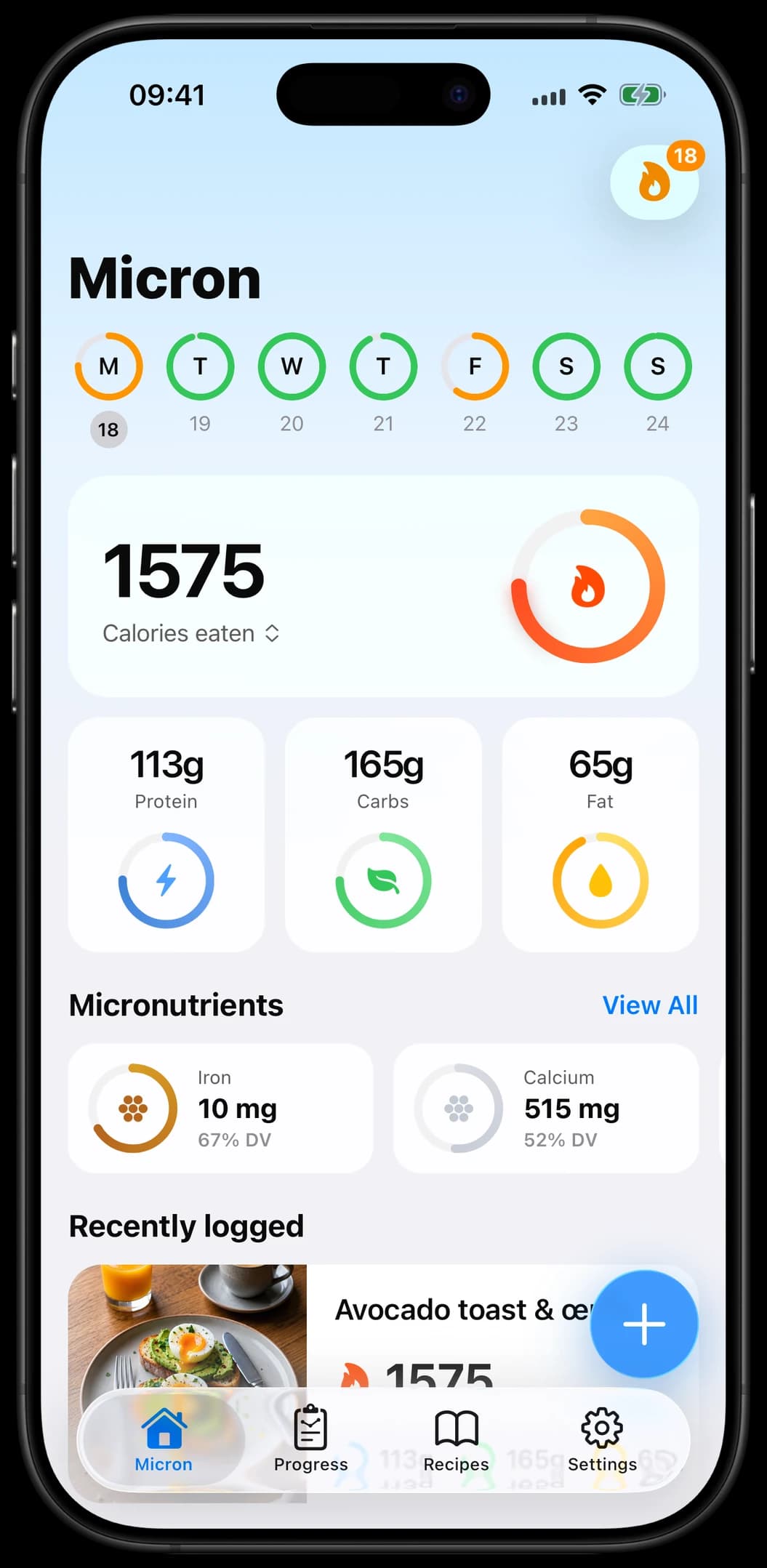
Track your calories from a photo.
Snap a photo of your meal: calories, macros and 30+ micronutrients, calculated instantly.


3. Who it (almost) doesn't work for
Let's be honest: recomposition isn't a universal solution. For these profiles, classic cut/bulk cycles deliver better results.
- Intermediate-to-advanced athletes (3+ years of regular training): your muscle-gain margin is small (0.1-0.2 kg/month). Trying to gain muscle in a deficit often means stalling on both fronts.
- Already-lean people (< 12 % body fat in men, < 18 % in women): your body protects its reserves. Muscle synthesis in a deficit becomes inefficient, and fat loss is compromised by hormonal drops (testosterone, leptin).
- Bodybuilders in contest prep: the precision required by competition isn't compatible with the approximation of recomposition. Classic cycles only.
- Lifters with significant excess weight (BMI > 30): priority is fast and meaningful fat loss. Recomposition produces results that are too slow here — a sustained moderate deficit is more effective for health and motivation.
4. The 5-step recomposition protocol
For eligible profiles, here's the protocol that works. Every parameter counts — neglecting one step compromises the result.
- Compute your TDEE then aim for maintenance or a very light deficit (-100 to -200 kcal/day): this is more delicate than a normal deficit — you need to be precise. Weigh your food for the first few weeks.
- High protein: 2.2-2.6 g/kg of body weight per day: that's more than a standard cut because you need to fuel muscle synthesis despite the energy deficit. The Longland et al. trial[3] is what shows this lever best: at identical deficit and training, the high-protein group gained lean mass where the low-protein group gained none. For 70 kg: 155-180 g/day, across 4-5 meals.
- Resistance training 3-4×/week with progressive overload: prioritize compound lifts (squat, deadlift, bench press, pull-ups), 8-12 reps, with weekly load progression. Without this stimulus, no muscle synthesis.
- Sleep 7-9 hours and manage stress: recovery and protein synthesis depend heavily on sleep. The available data show that short sleep degrades the body composition obtained at identical calorie intake — less lean mass preserved, more fat mass retained[7]. This is not a comfort detail: it is a parameter of the protocol.
- Patience (3-6 months minimum): recomposition is slow. The first visible signs appear at 8-12 weeks. At 6 months, changes are clear. Don't expect transformations in 4 weeks.
Calorie cycling to optimize
Advanced lifters on recomposition benefit from calorie cycling: maintenance on training days (higher intake to support performance and synthesis), light deficit on rest days (fat loss). This maximizes the muscle-gain to fat-loss ratio.
5. How to track progress when the scale doesn't move
This is the great difficulty of recomposition: the scale is misleading. You can lose 3 kg of fat and gain 3 kg of muscle — the scale shows 0 kg of difference even though your composition has completely changed. So you need alternative tools.
Progress photos (the most important)
Front, side, and back photos, in the same outfit (underwear or swimsuit), same lighting, same time (morning fasted), once a month. This is the most telling indicator. Photos reveal changes invisible day to day.
Targeted measurements
- Waist circumference (at the navel): indicator #1 of visceral fat. If you're losing fat, this measurement shrinks, even at stable weight.
- Hip circumference: indicator of peripheral fat (femoral-gluteal).
- Arm circumference (mid-arm flexed): indicator of muscle gained.
- Thigh circumference (mid-thigh at rest): indicator of muscle (overall thigh) and fat (femoral area).
Gym performance
If your loads are climbing on the compound lifts (squat, deadlift, bench, OHP) while maintaining good technique, your muscle mass is increasing. Systematically logging your sessions lets you see this progression over 4-12 weeks.
Body fat percentage (as a complement)
Consumer smart scales (bioelectrical impedance) are unreliable (±5 % error), but useful for tracking a trend (always measure under the same conditions). For accurate measurements, the DEXA scan ($60-100 in sports medicine clinics) remains the gold standard — useful at 0, 3, and 6 months to validate recomposition.
6. Recomposition vs classic cut/bulk cycles
The big question: should you do recomposition or alternate cutting and bulking? Let's compare both approaches honestly on the criteria that matter.
7. Common recomposition mistakes
The most frequent traps observed in coaching practice and across forums:
- Wanting to go too fast: recomposition is slow by nature (3-6 months for clear results). If you want to transform your physique in 8 weeks, opt for a short classic cycle — this isn't the right protocol.
- Underestimating intake: a light deficit demands precision. A 200 kcal/day error wipes out the entire deficit. Weigh your food for 4-6 weeks to calibrate your eye.
- Neglecting protein: without 2.2-2.6 g/kg, no muscle synthesis in the presence of a deficit. Non-negotiable.
- Doing too much cardio: cardio deepens the energy deficit but can hinder muscle synthesis if excessive (> 4 hours/week of intense cardio). Prioritize walking (NEAT) and short LISS sessions.
- Weighing yourself daily: the scale fluctuates ±2 kg over 3-7 days for hydration reasons. Weekly weigh-in under the same conditions, or better, monthly weigh-in + photos + measurements.
- Quitting too early: at 4 weeks, visible results are rare. It's between weeks 8 and 16 that recomposition becomes obvious. Hold the protocol for 3-6 months minimum.
Body recomposition vs classic cut/bulk cycles
The right choice depends on your profile and goals. Here are both approaches compared on the criteria that matter.
| Body recomposition | Classic cut/bulk cycles | |
|---|---|---|
| Speed of results | Slow (3-6 months for clear results) | Fast per phase (4-8 weeks of cutting = 4-6 kg) |
| Who it's for | Beginners, returning after break, high body fat % | Intermediate/advanced, in-shape athletes |
| Calories | Maintenance to -200 kcal/day | Deficit then surplus (cycles) |
| Protein | 2.2-2.6 g/kg | 2.0-2.5 g/kg |
| Main metric | Photos + measurements + strength | Scale + photos |
| Psychological phase | Flat — little visible variation short term | Sharp, motivating phase changes |
| Risk of error | High (narrow caloric window) | Low (broad caloric targets) |
| Recommended for⭐ | Eligible profiles seeking aesthetic change | Almost everyone otherwise |
Track your recomposition from a photo.
To start a body recomposition, calculate your maintenance and apply a light 100-200 kcal deficit.
Are you a good candidate for body recomposition?
4 quick questions to find out whether recomposition suits you, or whether classic cut/bulk cycles would work better in your case.
1. How long have you been training with weights regularly?
2. How would you estimate your body-fat percentage?
3. Are you returning after a long break (6+ months) or a total beginner?
4. How often can you train per week?
Answer the 4 questions to get your personalised diagnosis.
Disclaimer
This article is for information only and does not replace medical advice. Needs vary with age, sex and situation (pregnancy, conditions, medication): if in doubt or symptomatic, talk to a health professional.
Frequently asked questions
What does body recomposition mean?
Body recomposition means changing what your body is made of — losing fat and building muscle at the same time — rather than simply losing or gaining weight. Because the two changes offset each other on the scale, your weight can stay almost identical while your body visibly changes shape. It is often shortened to "recomp" in the fitness world, and it is the alternative to running separate cutting and bulking phases.
Can you really lose fat and gain muscle at the same time?
Yes, it's scientifically documented (Barakat 2020[1], Slater 2019[2]). The phenomenon is called body recomposition. It works well in beginners, people returning to training, and people with a high body fat %. In lean and advanced athletes, it becomes marginal and classic cut/bulk cycles produce better results.
How long until you see results from recomposition?
First visible signs (photos, measurements) appear at 8-12 weeks. At 6 months, changes are clear. At 12 months, transformation can be spectacular in a beginner (3-5 kg of muscle gained, 4-6 kg of fat lost, with body weight nearly stable). Recomposition is slow — that's its main limitation.
How much protein for body recomposition?
2.2 to 2.6 g per kg of body weight per day, or 155-180 g for a 70 kg person. That's more than on a classic cut (1.8-2.2) because you need to fuel muscle synthesis despite the slight energy deficit[3][5]. Spread it across 4-5 doses of 30-45 g, 3-4 hours apart: it is the total intake across the day and how it is spread out that count, far more than the exact timing of the dose around your session[6].
Body recomposition or bulking: which to choose?
Recomposition if: beginner, returning after break, high body fat %, aesthetic goal without urgency. Classic bulking if: intermediate/advanced, already lean (< 15 % M, < 22 % W), looking for clean and rapid muscle gain. For most experienced lifters, the cut/bulk alternation produces better results over 12 months.
What caloric deficit for body recomposition?
Very light: 100 to 200 kcal/day below maintenance, or about 5-10 % of TDEE. Beyond that, you switch into classic cutting mode and muscle synthesis becomes compromised. Many lifters on recomposition even run strict maintenance with calorie cycling (light deficit on rest days, maintenance on training days).
Do you need cardio during recomposition?
Moderate cardio yes, excessive cardio no. Daily walking (8,000-10,000 steps) raises calorie expenditure without hindering muscle synthesis. Intense cardio sessions should stay limited: 1-2 LISS sessions of 30 min/week max. Beyond that, cardio can interfere with recovery and muscle synthesis (concurrent training effect).
How many resistance training sessions per week?
3-4 sessions per week, focused on compound lifts (squat, deadlift, bench press, pull-ups, leg press). 8-12 reps per set, with progressive overload (loads climbing over 4-8 weeks). Below 3 sessions, the stimulus is insufficient for muscle synthesis in the presence of a light deficit.
Is body recomposition possible in women?
Yes, and it's particularly interesting. Women who are beginners or returning after a break can see excellent results: 2-4 kg of muscle gained, 3-5 kg of fat lost over 6-12 months, at stable body weight. The fear of « becoming too muscular » is unfounded — muscle gain is physiologically slow. Protein at 2.2-2.4 g/kg, lifting 3-4×/week, light deficit of 100-150 kcal/day.
How to measure progress when the scale doesn't move?
Four combined indicators: (1) monthly photos under the same conditions (the most telling), (2) targeted measurements (waist, arm, thigh) every 2 weeks, (3) gym loads progressing (log your sessions), (4) body fat % via smart scale (bioelectrical impedance, for trend tracking) or DEXA scan (gold standard). Never rely on the scale alone during recomposition.
Does body recomposition also work in seniors?
Yes, with adjustments. People aged 60+ benefit particularly from a recomposition protocol to fight sarcopenia (age-related muscle loss). Protein bumped to 2.4-2.8 g/kg, lifting 3×/week focused on legs and back, very light deficit or strict maintenance. Results are slower than at 30 but real and significant for health.
Scientific sources
This article draws on 7 peer-reviewed studies and publications, listed below. Every link points to the original source (PubMed, NIH, government agencies, scientific journals).
- [1]Barakat C, Pearson J, Escalante G, Campbell B, De Souza EO (2020). Body recomposition: can trained individuals build muscle and lose fat at the same time? (narrative review — Strength & Conditioning Journal 42(5):7-21, not indexed in MEDLINE, hence no PMID). Strength & Conditioning Journal. View source ↗
- [2]Slater GJ, Dieter BP, Marsh DJ, et al. (2019). Is an energy surplus required to maximize skeletal muscle hypertrophy associated with resistance training?. Frontiers in Nutrition. View source ↗PMID: 31482093
- [3]Longland TM, Oikawa SY, Mitchell CJ, et al. (2016). Higher compared with lower dietary protein during an energy deficit combined with intense exercise promotes greater lean mass gain and fat mass loss: a randomized trial. American Journal of Clinical Nutrition. View source ↗PMID: 26817506
- [4]Antonio J, Peacock CA, Ellerbroek A, et al. (2014). The effects of consuming a high-protein diet (4.4 g/kg/d) on body composition in resistance-trained individuals. Journal of the International Society of Sports Nutrition. View source ↗PMID: 24834017
- [5]Helms ER, Aragon AA, Fitschen PJ (2014). Evidence-based recommendations for natural bodybuilding contest preparation: nutrition and supplementation. Journal of the International Society of Sports Nutrition. View source ↗PMID: 24864135
- [6]Schoenfeld BJ, Aragon AA, Krieger JW (2013). The effect of protein timing on muscle strength and hypertrophy: a meta-analysis. Journal of the International Society of Sports Nutrition. View source ↗PMID: 24299050
- [7]Nedeltcheva AV, Kilkus JM, Imperial J, et al. (2010). Insufficient sleep undermines dietary efforts to reduce adiposity. Annals of Internal Medicine. View source ↗PMID: 20921542

About the author
Adrien Grusse
Founder of Micron
Adrien is the founder of Micron, the app that helps more than 150,000 users track their micronutrients daily. Before Micron, he worked on the Growth team at Finary (Y Combinator). Adrien is not a credentialed dietitian — his role here is to translate the scientific literature into accessible content, rigorously. Every article cites peer-reviewed sources (PubMed, Cochrane, recent meta-analyses); no claim is made without a verifiable reference. For individual medical follow-up, consult a healthcare professional.